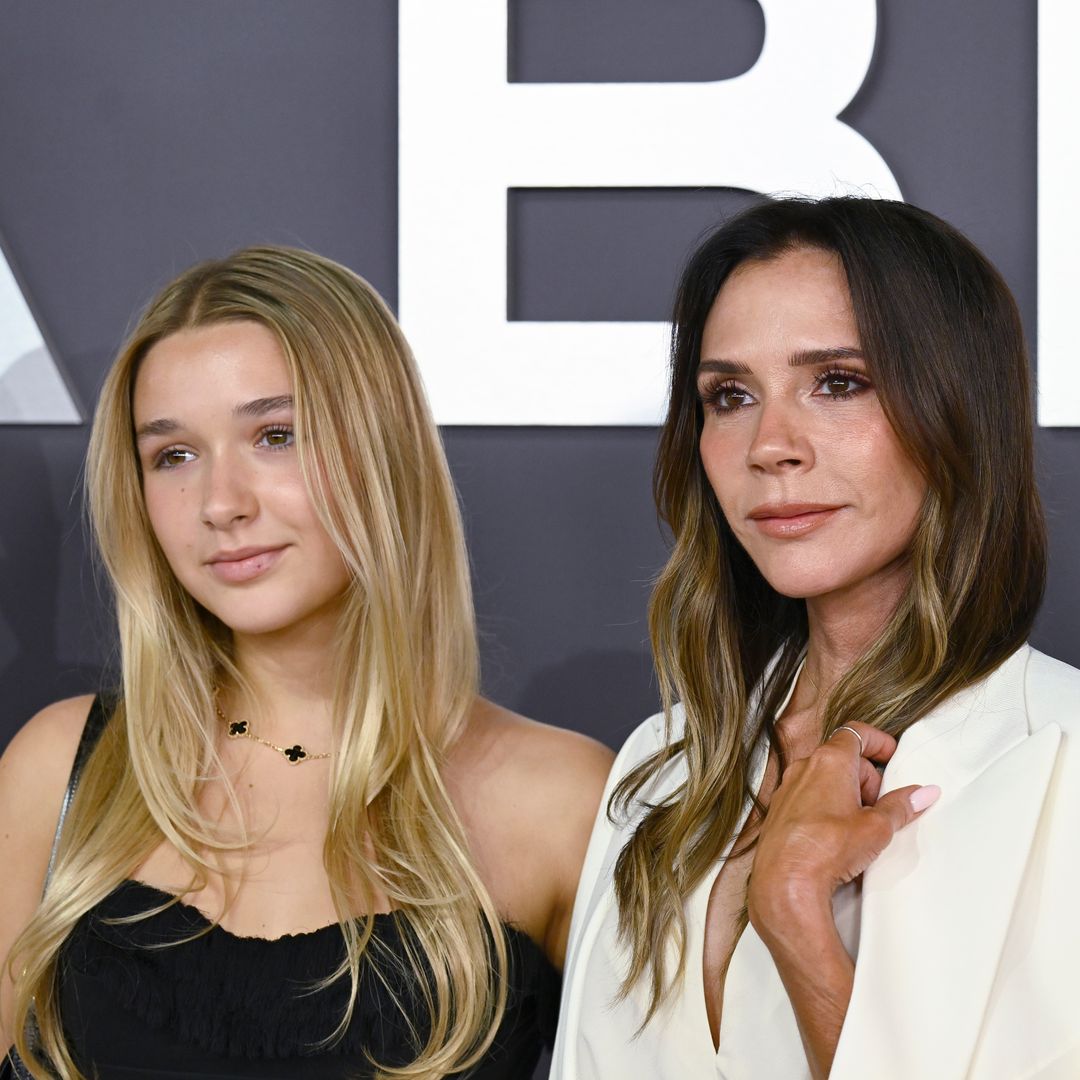
There's something weird going on in celeb-world. The industry's most famous women seem to be morphing into their daughters.
Take Victoria Beckham. In her Instagram post celebrating her 52nd birthday, she looked so similar to her 14-year-old daughter, Harper Beckham, that fans thought the photo was of Harper.
"Really thought you were Harper," one commented. Another added: "I thought it was Harper," while a third joked: "You’ve filtered yourself into Harper!"

Kris Jenner, via a series of expensive cosmetic surgeries, is looking more like Kim, Khloe and co. by the day, with one fan joking: "She looks younger than Stormi," referring to Kris' eight-year-old granddaughter.
 © Instagram
Closer to home, ITV icon Amanda Holden looks ever more like her daughters, Lexie, 20, and Hollie, 14.
 © Getty
While we're not privy to the inner workings of these women, it's easy to see why growing older at the same time your daughter is blossoming into a beautiful young woman could cause complicated feelings.
"Watching a daughter grow up while you are ageing can stir up something quite primal," acknowledges psychotherapist and author Anna Mathur. "It's not just about appearance (as culture often focuses on), it's more layered than that.
 © Olivia Spencer
"It’s about identity, time and visibility. You're witnessing your daughter move into a stage of life where society celebrates youth, possibility and growth, while you feel yourself moving into a phase that is less culturally celebrated. It’s quite a contrast and can trigger grief, comparison, reflection over your own life, and questions about worth, even in safe and loving relationships."
"Watching a daughter grow up while you are ageing can stir up something quite primal,"
Anna, whose new book, How to Stop Snapping at the People You Love (As Well As the Ones You Don't), is available for pre-order, is quick to point out that it's not a case of jealousy. "It’s not necessarily about wanting what your daughter has, but about becoming aware of what feels like it's shifting or being lost in yourself or is softening in you and blooming in her."
Self-criticism
Anna reiterates that these feelings don’t usually show up as obvious and overt jealousy. "More often, these feelings show themselves as increased self-scrutiny, a sharper inner critic, a sense of grief for what has passed or gone unlived, or a sense of urgency to hold on to what you have, whether that’s through aesthetic treatments, fitness, or comparison."
She continues: "Some mothers may notice themselves feeling more sensitive to ageing, more preoccupied with appearance, or even slightly uncomfortable/displaced in contexts they once felt more central/confident it.
"It can also show up emotionally and be a sometimes-confusing mixture of pride, protectiveness, grief, excitement, or a sense of being left behind."
Author and mother of two daughters, Louise Pentland, shared that she worried about how she'd feel when her daughter, Darcy, who recently turned 15, grew out of her childhood years and into her teens.
 © Instagram
"I grew up in a world where youth is the goal, and I often wondered if I'd wish I had as much collagen as Darcy or if the skin around my eyes were as smooth as hers," Louise says. "It was all the more complicated because my own mother died when she was only 37 (and I was seven) so I haven't experienced her ageing."
Louise adds that her complicated feelings towards having a teenage daughter were short-lived. "They were fleeting, because your maternal love overcomes. I love my daughters more than societal pressures. I love them more than myself."
Navigating this era
If you're struggling with this era yourself, Anna shares her expert advice: "The most helpful shift is to move from a place of self-judgement to awareness and understanding."
1. Remember you're not failing
"These feelings aren’t a failure of character; you’re not a bad person for feeling these layered feelings," Anna implores. "They’re a response to a culture that places enormous value on youth and often overlooks or skims over the richness and value of later stages of womanhood.
"When we can name what’s happening, both for ourselves and each other, the grief, the comparison, the fear of loss or becoming invisible, it softens its power."
2. Move away from appearance
Anna says that exploring how to expand identity beyond appearance can help, encouraging us to reconnect with what still feels alive, meaningful and growing in our lives and in ourselves.
"Consider the areas you want to strengthen, and the adventures you are yet to have," she says. "Ageing and growth and expansion can absolutely coexist, even if the world doesn’t always amplify this narrative."
3. Allow space
"It's also important to allow space for both truths: you can feel deep love and pride for your daughter, and also still feel the ache/grief/confusion of your own transition. Those things are not in conflict; they’re part of being human."
4. Reframe your thoughts
Clinical psychologist and author Lindsay Gibson recommends approaching the ageing process in a different way. "What if, instead of trying to turn back the clock, we looked at the ageing process as our own new phase of growing up, a chance to reconsider what we value in ourselves now as mature adults? By shifting our focus to what is most meaningful to us in our own time of life, we free ourselves to support our daughters' maturation without feeling threatened."
Louise's experience
On how she is navigating ageing alongside a teen daughter, Louise says: "I make the most of a good skincare routine, my CurrentBody mask is charged up ready for a red light blast and I have Botox in my forehead, but that doesn't mean I begrudge other women, let alone my own daughters.
"I do those things because they make me feel good. Same as wearing nice jeans or taking my magnesium. Think about what matters to you, without any comparisons, and follow that path."
 © Instagram
As for her advice for anyone struggling? "For any women worried about being outshone by their daughters – reframe it," she implores. "Think, 'Wow my daughters are GORGEOUS! Well done, Mama, you created and raised such a beautiful woman, how lucky I am to have a young lady like that in your life!'"
Louise concludes: "To age, naturally or with treatments that make you feel good, is a blessing. Each year earthside is a privilege, each year more you see how beautiful your children are becoming is a gift."
Lesley adds: "The time to start tackling these complicated feelings is before our daughter starts maturing. If you can make peace with your own life development, you'll be able to give her the positive attention and support she needs to build a confident, caring adult self, no matter what her age."