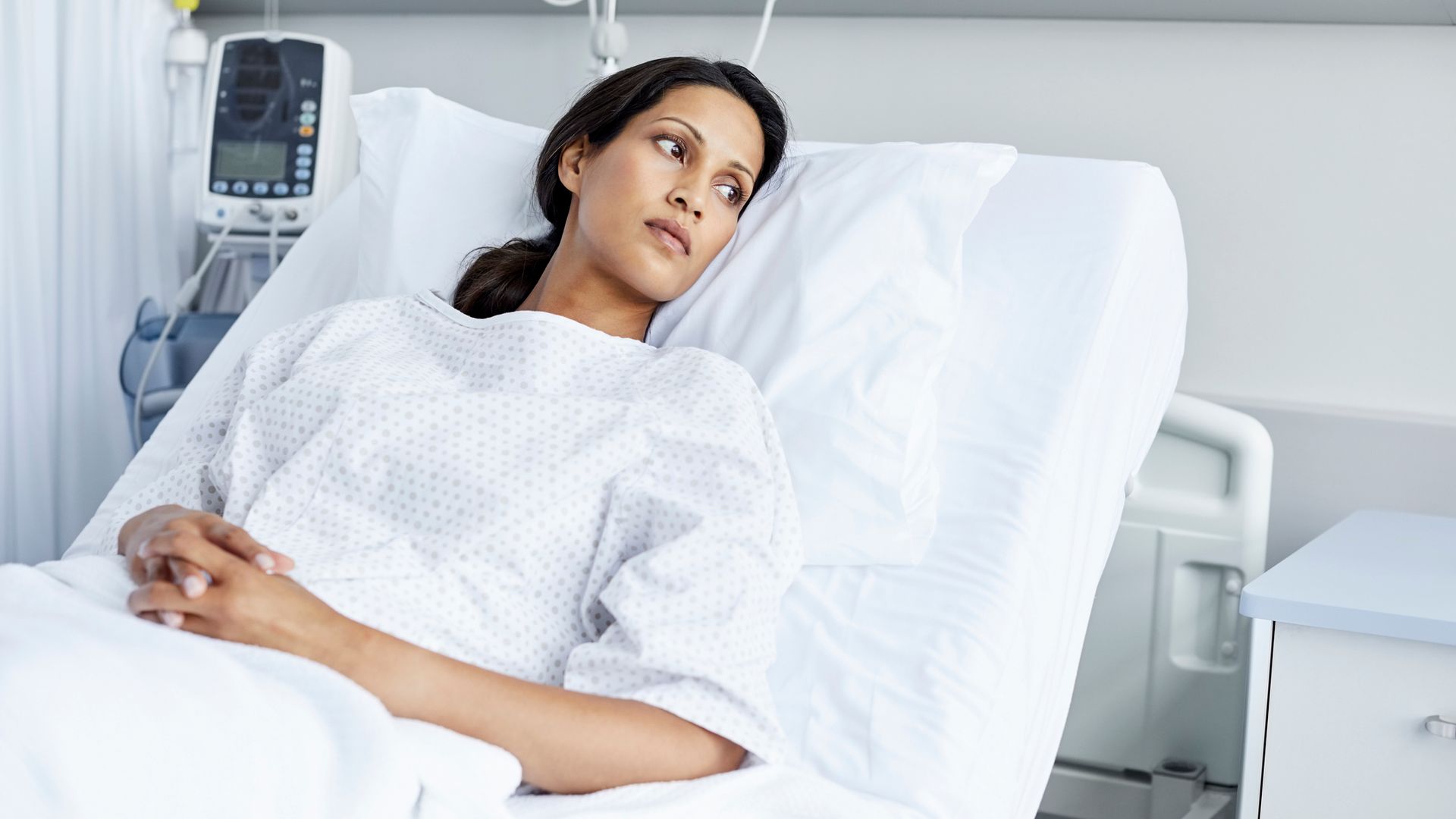

"If you had left it until 30, we would be having an extremely different conversation," said the white coat-clad, stern gynaecologist as she snapped her rubber gloves against her wrist and cleaned the cold, plastic Ayre spatula with a sterile wipe. It was a sentence that changed my perspective on health screening forever and carried words I knew I would never forget.
With my knees spread wide apart, I felt more than just physically exposed at that moment. I wasn't supposed to be there; I wasn't due for a smear for another three years, but in that time, my body would have been attacking me without my knowledge and growing abnormal cells that would more than likely lead to a cervical cancer diagnosis around my 30th birthday.
Interestingly, pre-cancer wasn't the reason I was lying back on a doctor's bed staring at the ceiling. The cause of my visit was something a lot less sinister, which ended up saving my life by accident. It was a painful Mirena coil and an unused HSE (Ireland's national health service) smear check-up that alerted me to my cells' aggressive CIN 3 changes. Had I not opted to have the contraceptive device inserted, I wouldn't have known about my Human Papillomavirus (HPV) until it was too late.
At this juncture, it is important to note that I had undergone a cervical smear as provided by the NHS once I turned 25, which came back all-clear, and received the Gardasil HPV vaccine when it was rolled out in schools across Ireland in the 2010s. I should have been protected, but it goes to show how fast your body changes, even when you least expect it.
What followed my initial smear results letter and doctor's appointment that felt like the realisation of my worst nightmare, as a severe hypochondriac, was months of sleepless nights. I was envisaging the worst and remained in the dark due to a lack of any open conversation around the virus or the commonality of the ordeal I was about to go through.
Referred to the national maternity hospital for further tests, terrifyingly foreign words like colposcopy, LLETZ (Large Loop Excision of the Transformation Zone), and cold coagulation were spiralling around my head. As my appointment date loomed closer, the unexpected seriousness of my cervix's condition weighed heavily on my mind, and I struggled to control my fear at having to visit the cancer ward to find out my fate.
After a plethora of invasive local anaesthetics, concerned frowning, tearful conversations and agonising waiting, I finally received my next letter. At home at the time, I heard the paper drop on the welcome mat and rushed to rip it open, willing it to be better news this time.
One glance over the glaringly bold black lettering, and I felt my stomach drop as I read that I had the most severe cell changes that would need removing before they turned nasty. Another date was listed for months down the line, and in the meantime, I would be left to quell my own anxiety and drive myself mad wondering what was going on inside my own body.
Almost eight months later, and a few dodgy cells lighter, I am still none the wiser as to how my cervix is doing and whether having the cold coagulation procedure has offered me the all-clear. Cue the arrival of another glorious white letter cordially inviting me back to the hospital to have another plastic spatula scrape at my insides.
If only there were a less invasive, less traumatic way to test for a virus that affects almost all women - and men - whether you are sexually active or not…
 © Getty Images
Introducing the menstrual blood–based HPV testing
It seems I'm not the only one who feels that something needs to change about the way health services around the world currently detect HPV and cervical cancer in women. The labs are busy working on a less invasive solution that would have saved me months of stress and worry as I lived my life in a state of uncertainty.
A revolutionary trial was invented that unlocked the potential to test menstrual blood on a sanitary pad or tampon for HPV DNA, without a Pap smear spatula in sight.
To further investigate the validity of this study, which was carried out on more than 3,000 women aged 20–54 years in Hubei Province, China, earlier this year, I spoke to Dr Hilary Jones.
They'd be able to do this test at home - I'm all for it.
With over 45 years of medical experience, the expert is most known for his segments on daytime TV, including his role as health editor on ITV's Lorraine. He weighed in on the possibility of a menstrual blood test and revealed why he was "all for it".
The doctor told Best Quality Designer Handbag : "Currently, we know that cervical screening saves about 5,000 lives a year, but we're missing out on millions of women who don't go for screening. They might be frightened, it might have been painful or uncomfortable, it might have meant a lot of embarrassment, there might be cultural reasons. We know that if we can make the test simpler, and less invasive, but just as accurate, it's a win-win in all ways."
He explained how the test worked: "The study compared looking for the cancer-causing HPV in menstrual blood flow, collected on cotton pads, to doing it in a traditional way. The testing on the menstrual blood flow was almost as good as traditional screening. There were very few false positives. It was a relatively small test, but if we can do more studies, which corroborate those findings, then we could roll that out and reach all those women who don't come in for traditional screening. They'd be able to do this test at home - I'm all for it."
 © Getty Images
What is HPV and why don't we talk about it?
Aside from the pain involved, most of the anxiety-inducing aspects of my experience were related to misinformation and a lack of conversation. I was confused and embarrassed as to how I had been diagnosed with HPV, as I hadn't really heard of it before, and what I had heard was attached to a massive stigma surrounding the virus, which is officially classed as the most common STI (sexually transmitted infection) worldwide.
The more I shared my health woes with my friends, the more I realised I was not alone in my diagnosis. So many women and men come into contact with HPV but are too afraid to share their experiences for fear of judgment.
You don't need to have normal sex to be exposed to HPV. It's on people's hands, just exploring people's bodies without having full sex can contribute to cervical cancer and transmission of HPV.
Dr Hilary explained: "It's true that it is, in a way, sexually active women who are at risk, which is almost all women, but what people don't realise is that the virus itself is prevalent in nature. It's not just affecting the cervix. You don't need to have normal sex to be exposed to HPV. It's on people's hands, just exploring people's bodies without having full sex can contribute to cervical cancer and transmission of HPV.
"People have assumed that it's sexually transmitted, but it's not just that. Men can also be affected by HPV, and as soon as women are sexually active, they're almost certain to be exposed to it because it's so prevalent. It shouldn't have that stigma, and hopefully raising awareness will help to dispel that myth!"
More personalised tests mean better results
The introduction of an at-home test would have helped me, and so many others, come to terms more quickly with our diagnosis and gain results faster. This would have eased anxiety and, for those lucky enough to receive all-clear results, saved them a scary trip to the doctor's office or worse, the hospital waiting room.
The expert has recently teamed up with Asda Pharmacy to encourage people to rethink where they go first for everyday illness and use the NHS's Pharmacy First service for self-testing and quicker detection of sickness.
"It avoids the embarrassment of going to see the doctor to get any tests done and just makes it more accessible to people. The more people know about these things, they'll say, 'There's no big deal', we don't have to go and see the doctor in the white coat sitting on the other side of the desk. That makes it very unfriendly and impersonal.
"If we can do these tests ourselves and have the knowledge of why we're doing them, that it's for our benefit, not for the doctor or the nurses' benefit, we will get more people going to their screenings, getting earlier diagnosis, and much better outcomes. We'll make healthcare more accessible to all, more conveniently, more quickly, and just as efficiently and just as safely. And that's got to be a win-win for everybody."
 © Smarts Agency
Dr Hilary Jones has over 45 years of experience as a medical doctor, having qualified from The Royal Free Hospital in London in 1976. He is best known for his appearances on television as a health advisor, especially on ITV's Lorraine as the show's former health editor.


